


EXCEL WORKBOOK · VOLUNTARY STANDARD (EU) 2026/1560
Your VSME report,
from bills to boardroom.
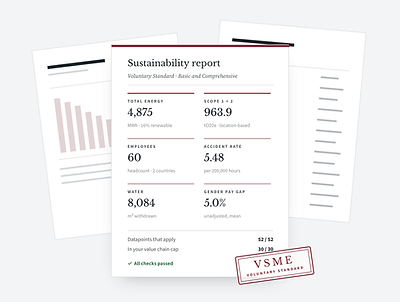
A do-it-yourself Excel workbook that prepares your sustainability report under the EU’s Voluntary Standard, the successor to EFRAG’s VSME. Enter your bills, logs and payroll register; get energy and emissions, workforce metrics, a value chain cap index and a print-ready report.
WHY NOW
Your customers will ask. Now there is a standard answer.
The Voluntary Standard entered into force on 24 September 2026. For companies with up to 1,000 employees it sets out what customers, banks and investors are expected to ask for – and, for financial years beginning on or after 1 January 2027, the most a customer may require from you for its CSRD reporting.
1,000
employees or fewer, on average in the preceding financial year: the Standard is intended for you (¶2).
Annex II
lists the value chain cap – one list for 10 employees or less and a longer one above 10. The workbook shows which is yours.
1 January 2027
Financial years beginning on or after this date are covered by the cap. Member States must transpose the protection by 19 March 2027.
WHAT IT DOES
Everything the Standard asks, in thirteen steps

Energy and emissions
From bills and logs to tonnes of CO2e.
Fuels, vehicles, refrigerants and electricity, converted to MWh and tCO2e
SEAI, DESNZ and IPCC factors, picked by name, on an AR5 or AR6 basis
Water, waste, pollution and biodiversity, site by site
Optional Scope 3 by the 15 GHG Protocol categories
COVERS
B3–B7 · Scope 3 · C3–C4

People and conduct
From a payroll export to every workforce metric.
Up to 1,000 employees, one row each – no names needed
Accident rate, minimum wage test and gender pay gap
Collective bargaining, training hours and turnover
Corruption and bribery, human rights and board diversity
COVERS
B8–B11 · C5–C9

Proof and report
Ready when someone asks “how do you know?”
59 datapoints, with your value chain cap marked
An owner, a source and a review status for each
17 checks and a status line on every tab
The statement of compliance and a print-ready report
INCLUDED
A complete worked example and a 26-page user guide
SIX THINGS IT HANDLES FOR YOU
The fiddly parts, done properly
1
Your value chain cap
The Index marks the Annex II datapoints a CSRD-reporting customer may require from you – one list for 10 employees or less, a longer one above 10.
4
Recordable accidents
It applies the Standard’s definition – death or more than three days’ absence – and gives the rate per 200,000 or 1,000,000 hours.
2
The 10-employee relief
With an average of 10 employees or less, the 20 datapoints the Standard tags as voluntary become optional. The workbook switches them for you.
5
Option A or Option B
Choose the Basic Module, or Basic and Comprehensive. The workbook works out which disclosures apply and leaves the rest out of the report.
3
Gas billed in gross kWh
Irish and UK gas bills show gross kWh. The workbook converts them to net calorific value for energy, as EFRAG’s guidance uses.
6
Questionnaires that quote VSME
Many still use the numbering of EFRAG’s VSME (December 2024). Every datapoint is mapped to its VSME paragraph, and a tab sets out what changed.
HOW IT WORKS
From bills to boardroom, in thirteen steps
You enter the bills, the logs, the payroll register and a few answers. The workbook calculates the metrics, tracks every datapoint of the Voluntary Standard – and checks the lot.
I. THE BUSINESS AND ITS CARBON
01 Setup
Undertaking, period, Option A or B, basis and size band
02 Sites
Geolocation, biodiversity-sensitive areas and water stress
03 Policies
Ten sustainability issues, targets and the business model
04 Energy & GHG
Bills, fuel cards and the F-gas log, turned into MWh and tCO2e
05 Climate
Scope 3 by category, reduction targets and climate risks
II. NATURE, PEOPLE AND CONDUCT
06 Environment
Pollution, water, waste, circular economy and materials
07 People
One row per employee, pasted from payroll – no names needed
08 Workforce
Accident rate, minimum wage, pay gap, bargaining, training and turnover – calculated
09 Governance
Corruption and bribery, human rights, revenues and board diversity
III. THE PROOF AND THE REPORT
10 Evidence
An owner, a source and a review status for every datapoint
11 Index
59 datapoints: does it apply, is it reported, is it in your value chain cap?
12 Dashboard
Key figures, charts and 17 checks
13 Report
The statement of compliance and the full report, ready to print or save as PDF

Dashboard: the year at a glance

Index: every datapoint and the value chain cap

Report: ready to print or save as PDF
THE USER GUIDE

See exactly what you are buying.
The 26-page user guide walks through every tab with screenshots: what to gather before you start, what you enter, what the workbook calculates and what to check before you move on. Read it before you buy.
Free · PDF, 26 pages, A4 · for Edition 1.0 of the workbook (October 2026).
QUESTIONS
Before you buy
Do we have to use Option B?
No. Option A, the Basic Module, is the minimum. Choose Option B if a customer, bank or investor asks for the Comprehensive Module – or if you want to show more.
We have 10 employees or fewer. What can we leave out?
The 20 datapoints the Standard tags as voluntary for undertakings with 10 employees or less – including energy, Scope 1 and 2, water and waste – become optional.
Is the report audited or assured?
No assurance is required under the Voluntary Standard. The workbook keeps an evidence and review trail, but Wide GAAP does not review or assure your figures.
Does it produce EFRAG’s Digital Template or XBRL?
No. It prepares the report and its figures. If a customer asks for the digital format, transfer the figures from the Report tab.
Can a UK company use it?
Yes. The factor library includes DESNZ factors for UK sites, and the Standard is voluntary and defined by size, not by country.
Which software do we need?
Microsoft Excel 2010 or later for Windows, or Excel 2011 or later for Mac. There are no macros, so nothing needs to be enabled.
GET THE WORKBOOK

Ready when your customer asks.
One Excel workbook: 13 working tabs, a complete worked example, a factor library, a comparison with VSME (December 2024) and a 26-page user guide. Excel 2010 or later for Windows, or Excel 2011 or later for Mac. No macros.
A do-it-yourself workbook: you prepare the sustainability report and remain responsible for it. Wide GAAP does not prepare, review or assure reports, and buying the workbook does not create an adviser relationship. Emission factors are as published by October 2026 – check for updates. General information, not advice.