



VSME Reporting Suite (Voluntary Standard 2026)
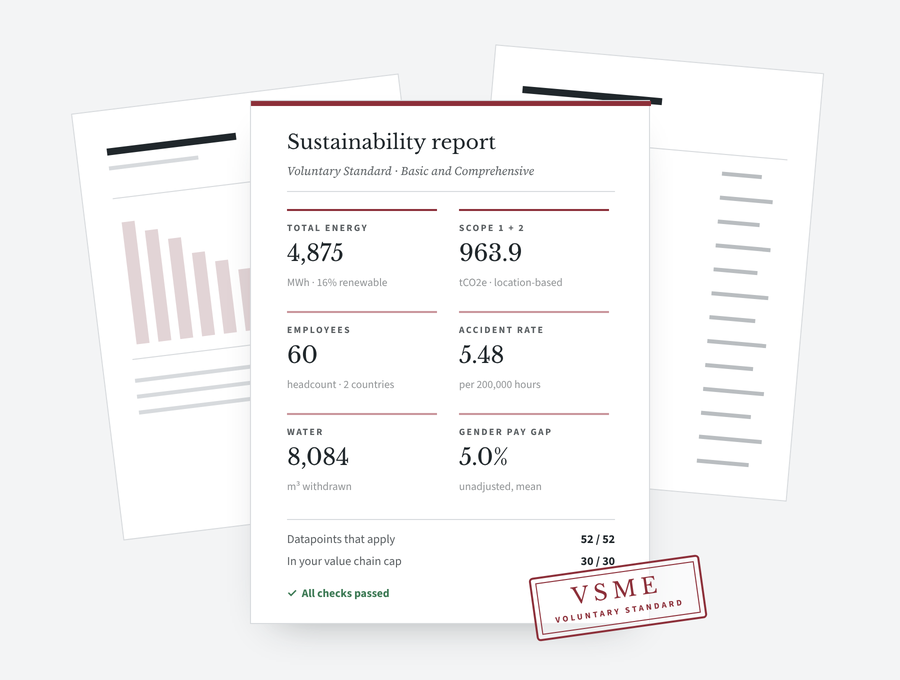
Large customers, banks and investors are asking smaller companies for sustainability data. The EU’s answer is the Voluntary Standard – Annex I to Commission Delegated Regulation (EU) 2026/1560, in force since 24 September 2026 and based on EFRAG’s VSME. The VSME Reporting Suite is a do-it-yourself Excel workbook that prepares your report under it: energy and greenhouse gas emissions, environmental and workforce metrics and governance, with a datapoint index, an evidence trail, 17 checks and a print-ready report.
You enter what you already have – energy bills, fuel records, the F-gas log, water and waste records, an employee register from payroll, your policies and a few answers. The workbook does the conversions, the calculations and the cross-checks. A complete worked example for a fictitious Irish packaging manufacturer shows exactly what goes where.
See what you are buying
The 26-page user guide walks through every tab with screenshots – free to read before you buy: read the user guide (PDF). Or see how the workbook works.
What it does
Converts fuels, vehicles, refrigerants and electricity into MWh and tonnes of CO2e – Scope 1 and location-based Scope 2 – with SEAI, DESNZ and IPCC factors you pick by name, on an AR5 or AR6 basis.
Calculates the workforce metrics from an employee register of up to 1,000 people: employees by contract, gender and country, accident rate, minimum wage test, gender pay gap, collective bargaining coverage, training hours and turnover.
Covers pollution, biodiversity, water by site, circular economy, waste and material flows – and, with Option B, Scope 3 by the 15 GHG Protocol categories, reduction targets, transition plan, climate risks, human rights, revenues from certain activities and board diversity.
Tracks the Standard as 59 datapoints: which apply to you, which are reported, which are voluntary for undertakings with 10 employees or less, and which are in your value chain cap – the Annex II list that, for financial years beginning on or after 1 January 2027, limits what a CSRD-reporting customer may require from a company with up to 1,000 employees.
Keeps an owner, a source, an evidence reference and a review status for every datapoint, with a findings log.
Generates the statement of compliance and lays out the full report, ready to print or save as PDF – with six optional extras that some lenders still ask for, such as market-based Scope 2 and GHG intensity.
Runs 17 checks, with a status line on every tab.
What you get
One Excel workbook (.xlsx): cover, instructions, 13 working tabs, a factor library, a comparison with VSME (December 2024) and the same 13 tabs completed for a fictitious company.
A 26-page user guide (PDF).
Clearly marked input cells, drop-down lists and protected formulas.
Works in Microsoft Excel 2010 or later for Windows, or Excel 2011 or later for Mac. No macros.
Who it is for
Companies with up to 1,000 employees – in Ireland, the UK and across the EU – that are asked for sustainability information by customers, banks or investors, and the finance teams, accountants and advisers who help them.
A do-it-yourself workbook
You prepare the sustainability report with this workbook and remain responsible for it. Wide GAAP does not prepare, review or assure reports for buyers of the workbook, and buying it does not create an engagement or an adviser relationship. No assurance is required under the Voluntary Standard.
Scope
Each copy prepares one report – for one company or one group – for one reporting period. The factor library holds Irish (SEAI) and UK (DESNZ) factors as published by October 2026; add your own for other countries or suppliers. Scope 3 uses the amounts and factors you supply. The workbook is not EFRAG’s Digital Template and does not produce XBRL. It presents the current year, so from your second year you add last year’s figures as comparatives. It is a working aid: it does not replace the Voluntary Standard, EFRAG’s guidance or professional judgement, and its scope and limitations are set out in the Instructions tab.
)