
Fair value hierarchy of investments priced using broker quotes
Updated: 1 hour ago
Under what fair value hierarchy should an investment valued using broker quotes be classified?
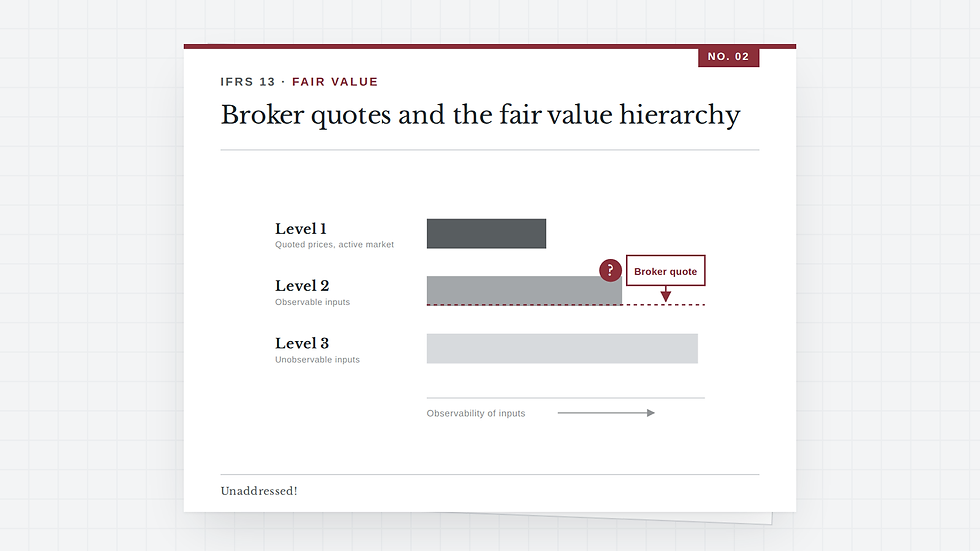
The source of the input (a broker or pricing service) is irrelevant; classification depends entirely on the nature and observability of the price itself. An unadjusted broker quote for an identical instrument in an active market is Level 1; a quote corroborated by observable market data (comparable transactions, or a broker standing ready to transact at that price) is Level 2; and an indicative-only quote from an inactive market, based on unobservable or proprietary model inputs with no commitment to transact, is Level 3.
Applicable Framework
IFRS 13 Fair Value Measurement governs this. IFRS 13:77 confirms that a quoted price in an active market for an identical asset is the best evidence of fair value and must be used without adjustment where available (Level 1), and IFRS 13:79 identifies the narrow circumstances permitting adjustment. Level 2 is defined in IFRS 13:81–82 as inputs observable directly or indirectly other than Level 1 quoted prices, including quoted prices for similar items in active markets or quoted prices for identical/similar items in markets that are not active. Level 3 is defined in IFRS 13:86–87 as unobservable inputs used only when relevant observable inputs are unavailable, reflecting management's own assumptions about what market participants would use. IFRS 13:B34–B47 (Application Guidance, integral to the standard) specifically address the use of third-party pricing information, including broker quotes. IFRS 13 does not preclude reliance on quotes from pricing services or brokers, but the entity remains responsible for determining the appropriate hierarchy level.
Analysis
The classification turns on three questions, none of which is answered simply because the source is a "broker":
1. Is there an active market for an identical instrument, and is the quote unadjusted?
If the broker quote is genuinely the unadjusted quoted price in an active market (per the IFRS 13 Appendix A definition — transactions occurring with sufficient frequency and volume to provide pricing information on an ongoing basis) for the identical instrument, and no adjustment under IFRS 13:79 is required, it is Level 1. This is the exception rather than the norm for broker-sourced pricing, since brokers typically operate in brokered or principal-to-principal markets rather than exchange environments, and single dealer quotes rarely meet the "active market for an identical item, unadjusted" test.
2. If not Level 1, can the quote be corroborated as observable?
A single broker quote supports Level 2 classification where there is observable market information on comparables corroborating the price, and/or the broker stood willing to transact at that price (i.e., it is an executable/binding quote rather than merely indicative). There are sets of equivalent conditions: the quote represents a price for similar assets/liabilities in an active market, is itself derived from a valuation technique whose inputs are observable, or can be corroborated against orderly transactions in an active or inactive market. IFRS 13:B47 gives more weight to quotes based on binding offers than to indicative quotes.
3. When does it fall to Level 3?
Where the market is inactive, transactions are infrequent, the broker relies on proprietary models with unobservable inputs, or the quote is provided purely as an indicative value with no commitment to transact (e.g. administrative pricing support with no binding offer), the input is unobservable and the measurement is Level 3. Multiple quotes from different brokers that diverge widely, or an entity's own estimate falling outside the range of broker quotes, are indicators that the underlying inputs are unobservable and further due diligence is required before concluding on the level.
Scenario | Likely Level | Key indicator |
Unadjusted quote, identical instrument, active market | Level 1 | No adjustment needed per IFRS 13:79; multiple sources available |
Quote corroborated by comparable observable transactions, or broker willing to transact at quoted price | Level 2 | Observable comparables or binding/executable quote |
Indicative-only quote, inactive market, proprietary/unobservable model inputs, no commitment to transact | Level 3 | No corroboration possible; wide dispersion across broker quotes |
Judgement and Edge Cases
This is a facts-and-circumstances determination requiring documented due diligence, not a mechanical rule. Management must understand how the broker or pricing service developed the quote whether it reflects actual, orderly transactions or a model output — before concluding on the level. A reviewer or regulator would challenge classification as Level 2 where the entity cannot evidence corroboration (e.g., via discussions with the pricing source, back-testing against actual transactions, or comparison to internal valuation model outputs). Indicators of a significant decrease in market activity — few recent transactions, quotes not based on current information, wide bid-ask spreads, or quotes varying substantially between market-makers (a specific risk in brokered markets per IFRS 13:B37), should trigger reassessment toward Level 3, even if the entity previously classified the same instrument as Level 2. If management adjusts a quoted price for any reason under IFRS 13:79, the result cannot remain Level 1 by definition and must be assessed as Level 2 or 3 depending on the adjustment's basis.
Presentation and Disclosure
IFRS 13:93 requires disclosure of the level within the hierarchy for each class of asset, and for Level 3 measurements, a reconciliation of opening to closing balances, quantitative information about significant unobservable inputs, and a description of the valuation process — obligations that are materially more onerous than for Level 1/2, which is a further reason the classification judgement needs to be made and documented carefully rather than defaulted. Where an entity relies on a third-party pricing service without independently corroborating the classification evidence, this is itself a disclosure and audit-evidence risk area regulators (e.g., FRC/ESMA thematic reviews) have historically flagged.
Practical Implementation
Document, for each material broker-quoted position: the pricing source, whether the quote is binding or indicative, the number of quotes obtained and their dispersion, and the corroboration procedures performed (comparable transactions, back-testing, internal model cross-check). This documentation is the audit evidence trail supporting the assigned hierarchy level and should be refreshed each reporting period, since market activity, and therefore the appropriate level, can change between periods for the same instrument.


Comments